Transfer, sale and tax rules for the family home in divorce
The stamp duty exemption on the transfer is wider than the surcharge disregard on the next purchase. Treating them as the same test is the common and expensive mistake.
5 mins read
22-09-2026
Written by

Editorial Team
Similar Guides


When a marriage or civil partnership ends, the family home is usually dealt with in one of three ways. It's sold and the proceeds are split, it's transferred to one party who buys the other out, or it's held under a court order that postpones the sale. Tax and family law outcomes turn on your own circumstances and the exact terms of any order, so this is general information rather than a substitute for advice from a solicitor and an accountant.
The three routes
Selling and splitting is the cleanest. Both parties leave with cash, there's no continuing connection, and neither is exposed to the other's later financial problems.
A transfer with a buyout keeps one party in the house, usually the one with the children. It depends on that person qualifying for the whole mortgage in their sole name, and that's where most of these arrangements come apart.
A Mesher order is a court order under which one party holds their interest in the home on trust for a limited period while the other lives there, with the sale triggered by a defined event such as the youngest child turning 18, remarriage or death.
The conveyancing side of a transfer
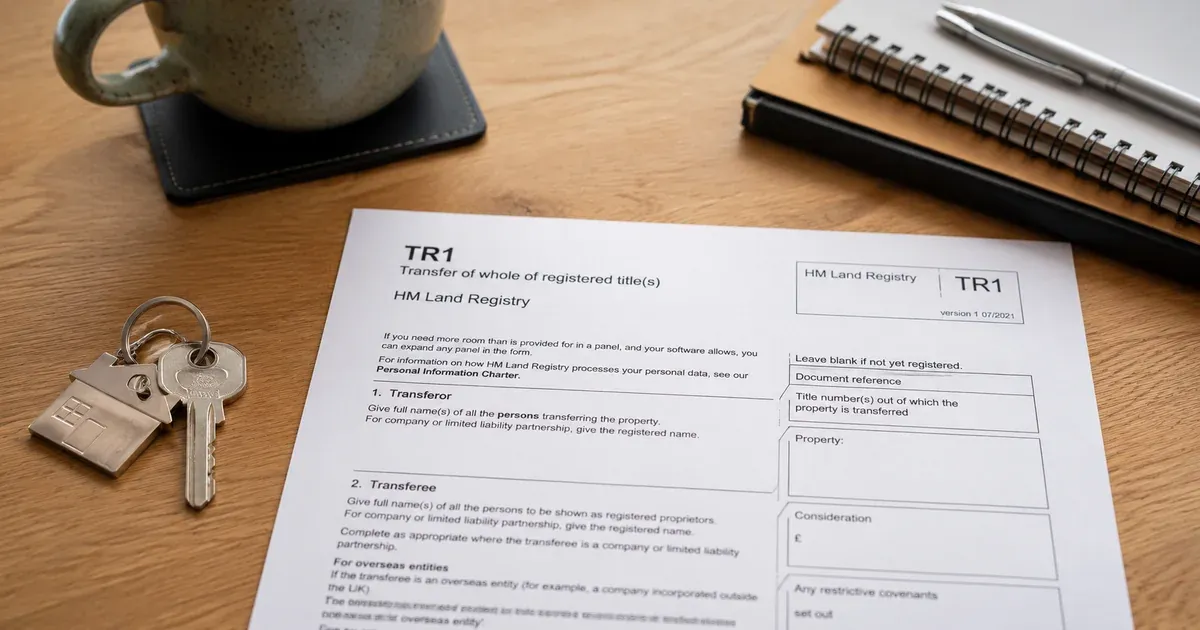
Moving the house from joint names into one name is a transfer of equity. The mechanics are a TR1 transfer deed, the existing lender's consent, a release of the outgoing party from the mortgage covenant, and registration at the Land Registry.
The lender's consent is the gate. A lender will only release one borrower if the remaining borrower qualifies for the entire loan alone, so in practice the buyout and the remortgage complete together.
Where a court order requires the transfer, the order doesn't move the legal title by itself. Someone still has to do the conveyancing, and building that cost into the settlement rather than arguing about it afterwards saves money.
Stamp duty on the transfer itself
A transfer of an interest in land between the parties, as part of an agreement or court order because they're divorcing, dissolving a civil partnership, annulling a marriage or legally separating, is exempt from stamp duty land tax in England and Northern Ireland. No return is needed, even where the value exceeds the threshold.
Scotland charges land and buildings transaction tax instead, administered by Revenue Scotland, and the reliefs there aren't identical.
Stamp duty when the leaver buys again
This is where the real money sits. Someone who's moved out but still holds an interest in the former family home would ordinarily be treated as owning an additional property, triggering the 5% surcharge on their next purchase.
Since 22 November 2017 that retained interest is ignored if three conditions are met: it isn't the buyer's only or main residence, it is the other person's only or main residence, and it's subject to a property adjustment order in their favour. HMRC's guidance on the higher rates and divorce or dissolution confirms that a consent order doing the work a property adjustment order would have done also counts.
The size of this is easy to underestimate. The table below shows the worked example.
Band | Rate | Amount |
|---|---|---|
£0 – £125,000 | 0% | £0 |
£125,001 – £250,000 | 2% | £2,500 |
£250,001 – £360,000 | 5% | £5,500 |
Standard SDLT subtotal | £8,000 | |
Additional property surcharge | 5% of £360,000 | £18,000 |
Total SDLT payable | £26,000 |
Please note: figures are illustrative for a £36,000 purchase at current SDLT rates and the 5% additional-property surcharge; always confirm against the buyer's actual purchase price. Note what the disregard requires. An informal separation agreement with no court order doesn't get you there. The exemption on the transfer itself is wider than the disregard on the later purchase, and treating them as one test is the most common error in this area.
Capital gains tax and the separation window
Transfers between spouses or civil partners who are living together happen at no gain and no loss, so no capital gains tax arises. Separation used to end that treatment abruptly.
For disposals on or after 6 April 2023, HMRC's guidance on transfers between separating spouses runs no gain no loss treatment to the earlier of the end of the third tax year after the one in which the couple stopped living together, or the date the court grants the divorce or dissolution. Transfers made in accordance with a formal divorce or separation agreement or a court order aren't subject to that time limit at all.
That second limb is what rescues most post-order transfers, so the three-year figure on its own is misleading. A party who moves out and later disposes of their interest can also claim under section 225B of the Taxation of Chargeable Gains Act 1992 to have the old home treated as their main residence for the period since they left.
That claim has a price. Relief can only be given on one residence for any given period, so claiming it on the old home loses it on the new one. Where you've already bought again, making the claim can be the wrong decision.
The Mesher order trap
HMRC treats a Mesher order as putting the interest into a settlement. That's a disposal of the whole asset into trust at the date of the order, even though the transferring party keeps an interest in it, and there's a second occasion of charge when the trust period ends and the house is sold.
Two occasions of charge isn't what most people expect from an order that simply delays a sale. Reliefs are usually available at both points, but only if somebody identifies the position when the order is made rather than a decade later.
Residential property gains are reported and paid within 60 days of completion, so if capital gains tax is in play the reporting deadline lands while the rest of the settlement is still unsettled. Raise it at the start of the financial discussion, and get quotes for the transfer of equity work so the conveyancing cost is a known number in the negotiation.