
Moving House Checklist 2026: Who to Notify Before, During & After Your Move
The DVLA, your council, your bank and dozens of other organisations need to know you've moved. Here's who to tell, and when.
5 mins read
04-08-2026
Written by

Editorial Team
Similar Guides

Moving house involves much more than packing boxes and hiring a removal company. Alongside organising your move, you'll need to tell dozens of organisations about your new address, from your bank and the DVLA to your council and utility suppliers. Some updates are simply good housekeeping, while others are legally important. For example, failing to update your vehicle's log book (V5C) with the DVLA can result in a fine of up to £1,000.
Whether you're buying, selling or renting, this guide explains who you need to notify, when to do it, and how to avoid common mistakes.
If you're still preparing for your move, our who to notify when you're moving house walks you through every stage, while our how to estimate and reduce the costs of moving home in the UK helps you budget for everything from conveyancing to removals.
About 2 months before: Get your Royal Mail redirection sorted early
Royal Mail redirection is one of the few jobs worth doing well ahead of moving day. You can apply up to six months before you move, and Royal Mail needs at least five working days to set it up, though it recommends applying around three weeks ahead so everything is ready in time. Redirection only covers post sent through Royal Mail itself, such as letters and cards, since parcels sent by other couriers and mail from some government departments are not covered.
Standard pricing for three months starts at £45.00 for a single-adult household, but it is not simply charged per person: a two-adult household pays £56.00 for three months, not double the single rate, and a three-adult household pays £67.00. Anyone receiving Universal Credit or Pension Credit can apply for a discounted concession rate instead, which brings the three-month price down to £24.50 for one adult or £32.00 for a two-adult household.
2 to 4 weeks before: DVLA, council tax and the electoral roll
This group is worth prioritising once your move date is confirmed, since a couple of these carry genuine deadlines rather than just being good housekeeping. This is general guidance rather than legal advice, and exact processes can vary depending on where you live.
Your driving licence and your vehicle's log book (V5C) are two separate DVLA records, so updating one doesn't update the other, and both should be updated as soon as you move. Changing your driving licence address is free, and updating your V5C is usually free too. Whichever you are updating, not telling DVLA about an address change risks a fine of up to £1,000.
You also need to tell both councils involved in your move, the one you're leaving and the one you're moving to, giving your moving date and, where possible, meter readings. How this works varies by local authority: some councils, including Oxford, will not let you start the online form until your move is fewer than 28 days away, so it is worth checking your own council's specific process rather than assuming a fixed turnaround.
Finally, your electoral registration doesn't move with you automatically. You'll need to register again at your new address, which takes about five minutes online and asks for your National Insurance number if you have one.
If you're buying a property and waiting to exchange contracts, our guide to how long conveyancing takes explains what to expect before your moving date is confirmed.
The week before: Everyone who holds your money or your risk
A shorter list of organisations, but an important one, since getting these wrong can cost you more than a missed letter.
- Banks, building societies, credit card providers and pension or investment platforms all need your new address before statements, renewals or fraud checks go out, so it's worth updating these before moving week rather than scrambling afterwards.
- Insurers are worth prioritising too: home, contents, car and life policies can all be affected by an address on file that no longer matches where you live, and a mismatch can complicate a claim at exactly the wrong moment.
On moving day and in the fortnight after
Photograph gas, electricity and water meter readings at both properties on the day you hand over or collect keys, and pass these to your suppliers so final and opening bills are accurate rather than estimated. Register with a GP and dentist near your new home if you haven't already, since NHS registration is local and doesn't transfer automatically with you. It's also worth updating your address with your employer or HMRC so tax code correspondence and your next P60 reach the right place, and ticking off smaller but easy-to-forget accounts such as your TV licence, streaming subscriptions, gym membership and any loyalty or delivery accounts tied to your old postcode.
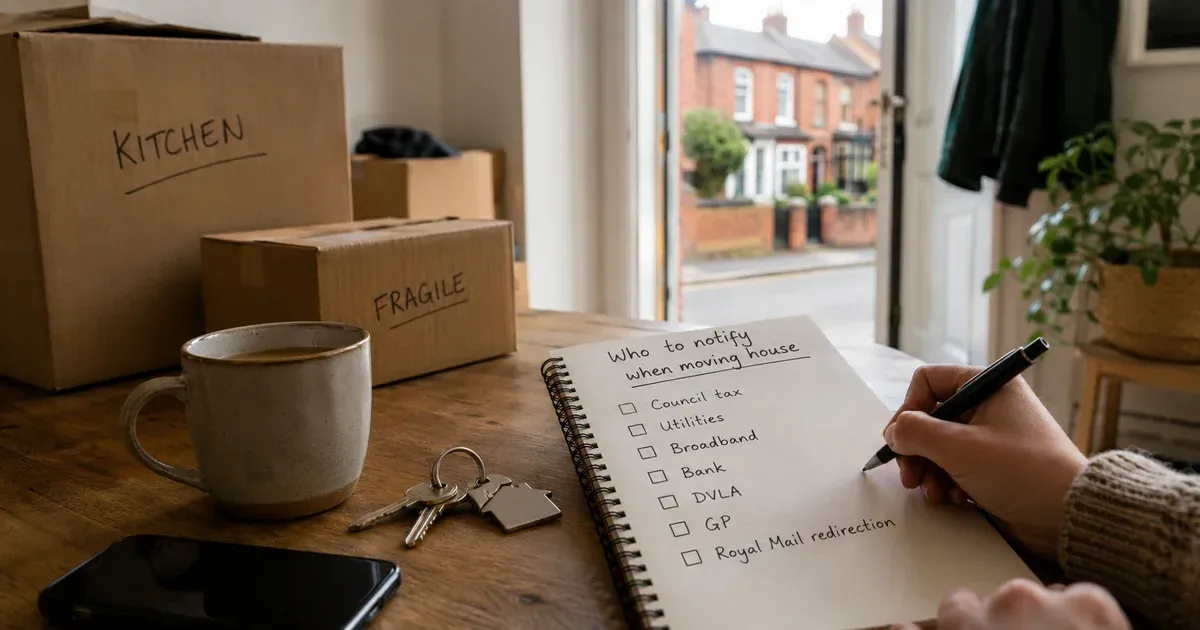
It's worth keeping a simple running list as you go, ticking off each organisation once you've had confirmation your new address is on file, rather than trusting yourself to remember which of the twenty-odd updates are still outstanding a fortnight after the boxes are unpacked.
The bottom line
None of these updates is complicated on its own, but they add up: DVLA, council tax, the electoral roll, Royal Mail, your bank and your insurer all need the same piece of information at slightly different times. Working through them in order, starting with Royal Mail redirection around two months out and finishing with meter readings on moving day, is the easiest way to make sure nothing falls through the cracks.
If you haven't sorted the move itself yet, our guide to the cost of moving house in the UK is a good place to start, and when you're ready, you can compare quotes from vetted local removal companies through Moving Compared to see who can move you for the best price.