What your title plan really shows in a boundary dispute
The red line on your title plan is not your legal boundary, and Land Registry says there is no standard margin of error.
5 mins read
02-11-2026
Written by

Editorial Team
Similar Guides

A title plan does not tell you where your legal boundary runs. Under the general boundaries rule in section 60 of the Land Registration Act 2002, the line on an HM Land Registry title plan is a general boundary and does not determine the exact line of the boundary.
HM Land Registry is blunt about the margin involved. Its guidance on plans and boundaries says there is no standard tolerance, measurement or ratio that can be attributed to the relationship between the general boundary on the title plan and the legal boundary. It adds that case law sets no limit on the quantity of land that can fall within the rule.
Where the legal boundary comes from
The legal boundary is an invisible line with no width. It is fixed by the pre-registration conveyance or the transfer that first divided the two plots, read as a whole including its plan. Where the plan is not clear enough for a reasonable layperson to place the line, a court looks at the physical features on the ground at the time.
The test is what a reasonable layperson would have thought they were buying. What the original parties privately believed or intended is irrelevant, so a neighbour’s memory of a conversation in 1987 does not move the line.
The fence beliefs with no legal basis
The idea that the posts and rails of a fence sit on the owner’s side, or that you always own the boundary to your left, has no legal foundation. HM Land Registry says there is no rule that the fence, wall or hedge on the left or right of a property belongs to that owner. It adds that a covenant to maintain a wall or fence does not by itself confer ownership of it. Where neither ownership nor responsibility can be established, the feature is generally best treated as a party boundary. Estate covenants can also control what you do with a fence, which is a separate question from who owns it.
T marks on a deed plan that are not referred to in the text of the deed have no special force or meaning in law. HM Land Registry will normally ignore them unless an applicant specifically asks for them to be shown.
Determining the exact line
Where you want the line recorded precisely, you can apply for a determined boundary under section 60 of the 2002 Act and rule 118 of the Land Registration Rules 2003. The application goes in on Form DB with a plan identifying the exact line, showing the start, end and any turning points, preferably as lettered points. A chartered land surveyor or other suitably qualified professional will normally have to certify that the measurements are accurate to within 10mm. You also need evidence that the line is where you say it is.
HM Land Registry’s published fee for determining a boundary is £90 per application, the same whether you apply through the portal or by post. The surveyor’s plan is the real expense. The registration fee is usually the smallest part of the exercise. The table below sets a general boundary and a determined boundary side by side.
General boundary (the default) | Determined boundary | |
|---|---|---|
What the register shows | An approximate line, not the exact one | The exact line of the boundary |
Plan needed | None beyond the title plan | Surveyor’s plan, normally certified to within 10mm |
HM Land Registry fee | None | £90 per application |
Settles a disagreement? | No | No |
The limits matter as much as the procedure. HM Land Registry does not resolve a disagreement about where the boundary lies. It decides whether the plan identifies an exact line and whether the applicant has shown an arguable case, then gives notice to the adjoining owner. If that owner objects and the objection is not groundless, the matter goes to the Land Registration division of the Property Chamber of the First-tier Tribunal unless the parties can reach agreement.
Boundary agreements are usually the better route
An agreement with the neighbour is usually cheaper and quicker, as long as the neighbour is willing. A boundary agreement that simply demarcates an unclear line, rather than consciously transferring land, falls outside the formality rules and does not have to be in writing to be enforceable. It is still sensible to put it in writing and have both sides sign. There is a rebuttable presumption that no land is transferred by it.
In White v Alder, decided by the Court of Appeal in April 2025, a boundary agreement demarcating unclear boundaries was held to bind successors in title who had no knowledge of it. The Supreme Court refused permission to appeal in October 2025. If you are buying, that means a line your sellers settled with the neighbour years ago can bind you without appearing in any of the papers you were given.
The cost reality
Boundary disputes are a classic case where the legal bill can dwarf the land at stake. A strip a metre wide behind a semi is worth very little, while a contested tribunal reference with expert evidence on both sides is not cheap. HM Land Registry warns that applying for a determined boundary without the consent of all the neighbours involved risks a costly dispute before the First-tier Tribunal.
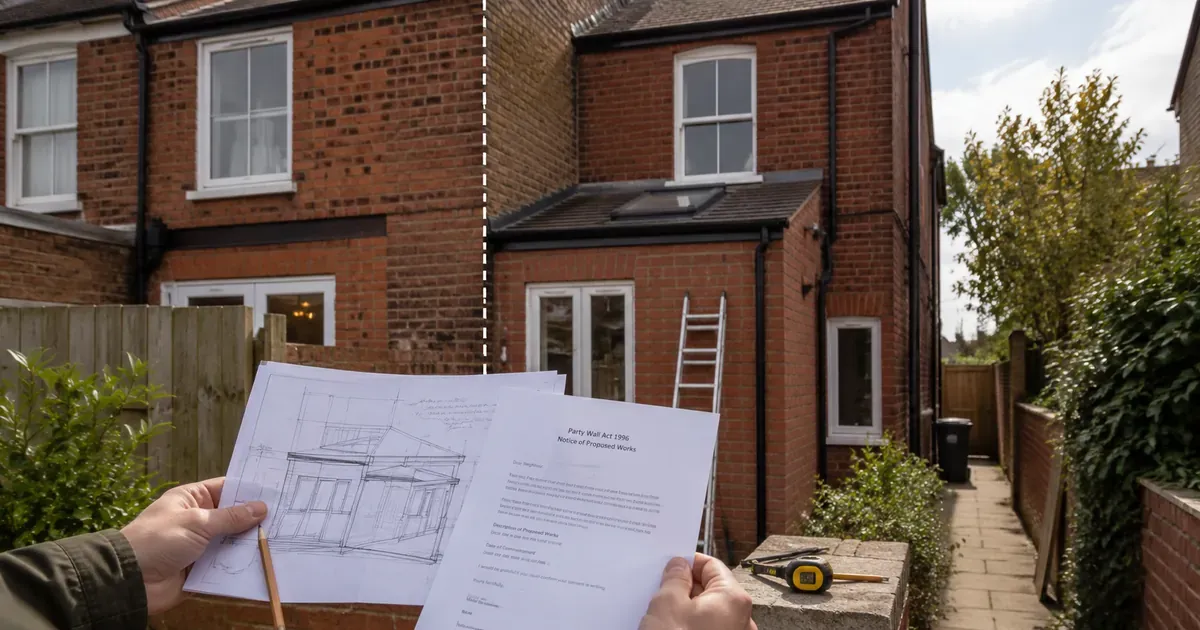
HM Land Registry makes a point that is easy to overlook. It says the process of agreeing a boundary line with a neighbour, whether for an agreement or for a determined boundary application, can itself generate forceful differences of opinion where none existed before. Raising the question is not a neutral act, and in a good many cases the sensible answer is to leave a settled arrangement alone. Building work near a shared boundary is a different matter, and the Party Wall Act explained covers when a formal agreement is needed.
Before exchange, walk the boundary with the title plan in hand and note every point where the fence, hedge or wall does not match the red line. A mismatch is not a defect in itself, given the general boundaries rule, but it is the most useful thing you can raise while you still have the option of walking away. Our list of questions worth putting to a conveyancing solicitor covers what to ask before you instruct, and you can compare conveyancing quotes once you know what you need.