
Rising damp vs penetrating damp and what a damp survey tells you
"Damp" in a survey report sounds bad, but it can mean anything from a blocked gutter to a failed damp-proof course. Here's how to tell which you're facing, and whether it should change what you pay.
6 mins read
30-09-2026
Written by

Editorial Team
Similar Guides


The three types of damp you'll come across
Damp is one of the most common house survey problems, and one of the most misunderstood. The word covers three quite different problems, and they have very different causes, fixes and price tags. Knowing which one you're dealing with is most of the battle.
Rising damp
Rising damp is groundwater being drawn up through the bottom of a wall, a bit like a sponge sitting in a puddle. It happens when a house has no damp-proof course, or when the one it has has failed or been bridged. It only affects ground-floor walls and floors, and it's far more likely in older homes built before about 1919.
Penetrating damp
Penetrating damp is water getting in from outside, usually sideways through a wall or down from the roof. Leaking gutters, cracked render, worn-out pointing, slipped roof tiles and blocked downpipes are the usual culprits. It can show up on any floor, and it tends to get worse after heavy rain.
Condensation
Condensation is moisture from inside the house (cooking, showers, drying clothes, even breathing) settling on cold surfaces. It's the most common type by a distance. The Energy Saving Trust puts it simply: rule out leaks and rising damp, and the problem is almost certainly condensation. It's also usually the cheapest to sort out.
Type | Where it shows | Usual cause | Typical clues |
|---|---|---|---|
Rising damp | Bottom of ground-floor walls, up to about 1m | Failed, missing or bridged damp-proof course | Tide mark, salts, crumbling plaster, rotting skirting |
Penetrating damp | Any wall or ceiling, any floor | Leaks from gutters, roofs, pointing or render | Isolated patches that worsen after rain |
Condensation | Cold spots, windows, corners, behind furniture | Moisture from everyday living with poor ventilation | Black mould, streaming windows, musty smell |
Rising damp signs, and why it's so often misdiagnosed
The classic rising damp signs are a tide mark along the bottom of ground-floor walls, usually no higher than about a metre, with crumbly or salty plaster below it. You might see white, fluffy salt deposits, peeling paint or rotting skirting boards, and the damage should be worst at the bottom and fade as it goes up.
Here's the catch. Rising damp is rarer than most people think. The Society for the Protection of Ancient Buildings warns that it's widely misdiagnosed on the strength of moisture meter readings alone. Those handheld meters measure electrical conductivity, not water, so salts, foil-backed plasterboard or even some paints can make a dry wall read as wet.
Plenty of "rising damp" turns out to be something else entirely. Soil or a patio built up against the wall above the damp-proof course is a common cause. So is a leaking pipe, a blocked gully or a hard cement render that traps moisture in an old brick wall. Fix those and the damp often goes away on its own, without any chemical injection.
What your home survey will say about damp
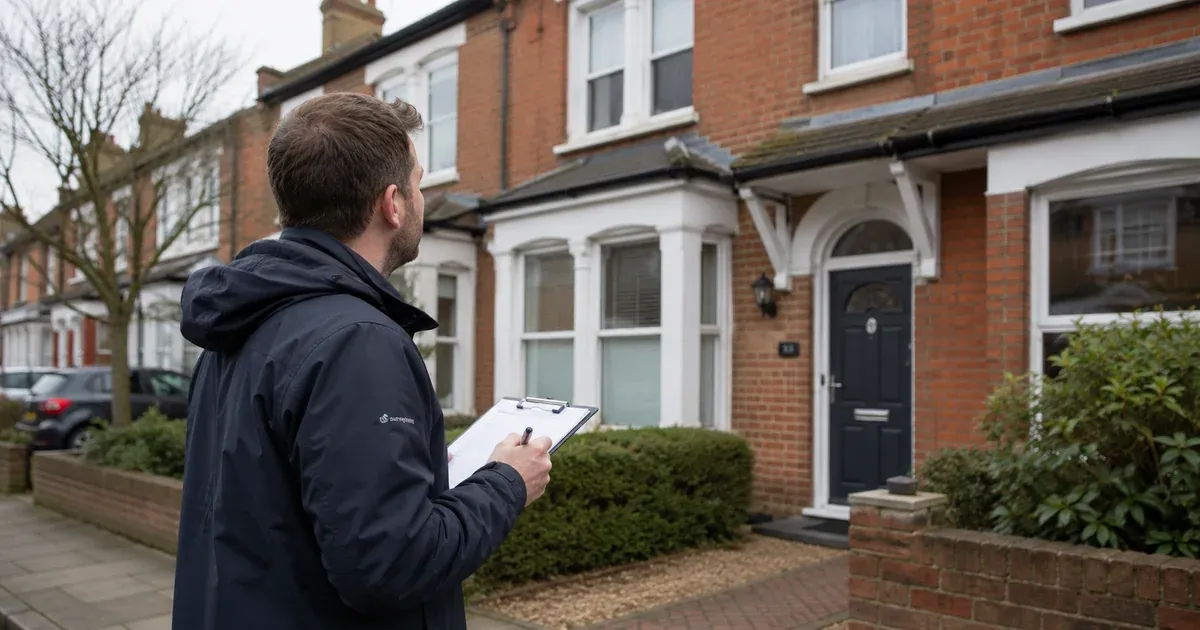
A RICS Level 2 or Level 3 survey will almost always mention damp if the surveyor finds signs of it. They'll usually take meter readings at the base of walls and around windows, look for staining and mould, and check the outside of the house for obvious causes like leaking gutters or high ground levels.
What they won't do is pull off plaster or drill into walls. So a survey report will often say something like "damp readings were recorded, further investigation recommended". That's not a verdict. It's a prompt to find out more before you commit. If you're not sure how to read that kind of wording, our guide on how to read a home survey report goes through the condition ratings and what they mean.
For older houses in particular, a Level 3 survey gives more detail on causes. Our guide to the best survey for Victorian houses explains why.
When to get a separate damp survey
A separate damp survey makes sense when your home survey flags damp it can't explain, when you can see clear signs yourself, or when your lender asks for one. Some mortgage lenders do ask for a specialist damp and timber report before they'll release the funds, especially on older properties.
Who should do it
This matters more than anything else in the process. Many damp surveys are offered free or cheaply by companies that also sell damp-proofing treatments, and SPAB, among others, points out the obvious conflict of interest.
Where you can, pay for an independent damp survey from someone who isn't going to quote for the work. Look for a chartered surveyor with experience of your type of building, or a specialist with the CSRT qualification (Certificated Surveyor in Remedial Treatment) through the Property Care Association. For a period home, it's worth finding someone who understands traditional, breathable construction.
What a good damp report includes
A decent damp report should tell you what type of damp it is, where it's coming from and why. It should include moisture readings, photos and ideally the results of tests that go beyond a meter, such as a salt analysis or a sample drilled from the wall. Then it should recommend a fix that targets the cause, not just the symptom.
Be wary of any report that jumps straight to "inject a new damp-proof course and replaster in waterproof render" without explaining what's causing the damp in the first place.
What it costs to fix damp
Costs vary a lot with the size of the problem and how much making good is needed afterwards, but these figures give you a sense of scale.
Fix | Typical cost |
|---|---|
Damp survey | £100 to £600 (average £300) |
Injected damp-proof course (rising damp) | £60 to £200 per metre, usually £1,000 to £3,000 |
Physical damp-proof course (rising damp) | £2,500 to £7,500 |
Penetrating damp repairs to external walls | £1,000 to £3,000 |
Extractor fan (condensation) | Around £300 |
Cellar tanking | £100 to £200 per square metre |
Please note: Typical costs from Checkatrade, 2026. Replastering and redecorating are usually extra.For most buyers, the good news is that the cheaper fixes are also the most common. Clearing a gutter, lowering a flower bed or fitting a proper extractor fan costs a fraction of a new damp-proof course, and it's often all that's needed.
Should you renegotiate the price?
Sometimes, yes. Damp that needs real work is a fair reason to go back to the seller, especially if it wasn't obvious at viewings. It's much less convincing if it's minor condensation you could fix for the price of a fan.
When it's worth pushing
It's worth renegotiating when an independent report confirms a real problem, such as failed pointing across a whole wall, a leaking roof or confirmed rising damp, and you've got written quotes for the work. Quotes are what make the conversation work. "The survey found damp" is easy for a seller to shrug off. "We've had two quotes averaging £4,000 to fix it" is much harder.
You can ask for a price reduction, ask the seller to do the work before completion, or agree a mix of the two. Our guide on negotiating after a home survey covers how to approach it.
When it probably isn't
If the only issue is a bit of condensation and mould in the bathroom, or a single damp patch under a gutter that needs clearing, most sellers (and their agents) will see that as normal maintenance. Push too hard on small things and you risk souring a deal over a problem that costs less than your survey did.
Before you exchange
Damp sounds alarming in a survey report, but it's usually fixable and often cheaper than people fear. The key is finding out which type you're dealing with and what's causing it before you commit. If you haven't booked your survey yet, you can compare RICS surveyors and get one in place for the house you want.

FAQs
Related Guides

RICS Level 1 surveys explained
5 mins read
What is a Home Report in Scotland?
5 mins read