
Signs of subsidence and how a surveyor checks for it
Most cracks in a house are nothing to worry about. Here's how to spot the few that are, and what a surveyor or structural engineer will do about them.
7 mins read
30-09-2026
Written by

Editorial Team
Similar Guides


What subsidence actually is
Subsidence is when the ground under a house sinks and takes part of the foundations down with it. The key word is part. If a whole house dropped evenly, you'd barely notice. The damage comes when one corner or one side moves more than the rest, and the walls crack as they try to follow.
It's worth knowing the two terms that get mixed up with it. Heave is the opposite, when the ground swells and pushes the foundations up, often after a large tree has been removed from clay soil. Settlement is the normal bedding-in that happens as a new building compresses the ground under its own weight. Settlement usually stops after the first few years and leaves small, stable cracks behind.
Most subsidence in the UK comes back to clay. The British Geological Survey explains that clay soils swell when wet and shrink when dry, and the formations most prone to it are in the south-east, including much of London. Add a thirsty tree close to the house or a leaking drain washing soil away, and you have the usual suspects.
The signs of subsidence to look for
When you're viewing a house, you're not trying to diagnose anything. You're just looking for reasons to ask more questions.
Cracks that follow a pattern
The classic warning sign is a diagonal crack that's wider at the top than the bottom, often running out from the corner of a window or door. In brickwork it tends to step along the mortar joints like a staircase. The Association of British Insurers suggests treating diagonal cracks wider than 3mm as worth a closer look.
Pay attention to where the cracks are, too. Cracks you can see on both the inside and outside of the same wall matter more than a line in the plaster. So does a crack where an extension or bay window meets the main house, since a gap opening up there suggests the two parts are moving separately.
The less obvious clues
Doors and windows that suddenly stick, when they didn't before, can mean their frames have been pulled out of square. Other clues include rippling wallpaper at the junction of walls and ceilings (with no sign of damp behind it), gaps opening between skirting boards and the floor, and floors that slope noticeably.
Look outside as well. A large tree within a few metres of the house, fresh pointing or filler in just one area of brickwork, and a newly redecorated room that doesn't match the rest are all worth asking about.
Cracks vs structural movement
Here's the reassuring part. Almost every house has cracks, and most of them mean nothing. The hard part is telling the difference.
Hairline cracks in new plaster are usually just shrinkage as it dries. Fine lines where the walls meet the ceiling often come from timber expanding and contracting through the seasons. Neither is a sign that the building is moving.
Surveyors and engineers often grade cracks using a scale published by the Building Research Establishment, which runs from category 0 to category 5 based mainly on width. Cracks up to around 5mm (categories 0 to 2) are generally treated as cosmetic and fixed with filler and paint. Categories 3 and 4 start to affect how the building works, such as doors sticking or rain getting in. Only category 5, above 25mm, is classed as structural damage likely to need major repair.
Category | Typical crack width | What it usually means |
|---|---|---|
0 to 2 | Up to about 5mm | Cosmetic, fill and redecorate |
3 to 4 | 5mm to 25mm | Serviceability, may affect doors, windows and weathertightness |
5 | Over 25mm | Structural damage, likely to need major repair |
*Based on the Building Research Establishment's crack damage categories.Width isn't the whole story, though. A 2mm crack that's been the same for twenty years is far less worrying than a 2mm crack that was 1mm last spring. That's why the most useful question isn't how big a crack is, but whether it's still moving.
How a surveyor checks for subsidence
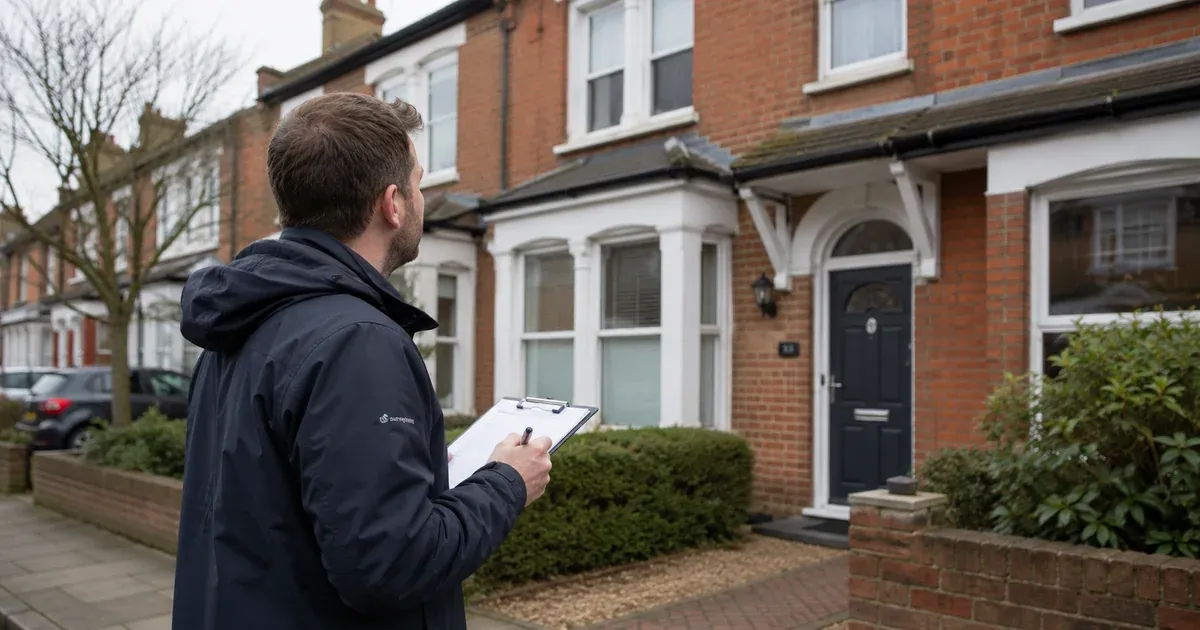
A standard RICS survey is a visual inspection. The surveyor won't lift floorboards, move heavy furniture or dig up the garden. What they will do is look at the property as a whole and join the dots.
Inside, they'll check walls and ceilings for crack patterns, test whether doors and windows open freely, and look for sloping floors or distorted frames. Many will use a spirit level or a laser, and some carry a crack-width gauge to record exactly what they find. Outside, they'll look at brickwork, the line of the roof, the junctions with extensions, nearby trees and the condition of drains they can see.
They'll also think about the context. What's the soil like locally? Has the area had problems before? Has part of the house been freshly decorated or repointed in a way that might be hiding something?
Level 2 or Level 3?
A RICS Level 2 survey (often still called a HomeBuyer Report) will flag signs of movement, but it doesn't go into much detail about cause. A Level 3 building survey, which a lot of people still call a structural survey, goes further. It describes the defects, discusses likely causes and gives a view on what needs to happen next. If you're buying an older property or one on clay, our comparison of RICS Level 2 vs Level 3 surveys will help you pick, and our guide on how to spot subsidence in period properties covers the specific issues older homes face.
When you need a structural engineer report instead
A surveyor is a generalist who looks at the whole building. A chartered structural engineer is a specialist who looks at one question: is this structure sound, and if not, why not? If a surveyor finds cracking they can't explain, or thinks movement might be ongoing, their report will usually recommend a structural engineer before you commit to buying.
You'll typically want a structural engineer report when the survey recommends further investigation of movement, when cracks are wider than about 5mm or appear on both sides of a wall, when the house has had subsidence or underpinning in the past, or when your mortgage lender asks for one.
The engineer will look at the cracks in detail, work out the likely cause and advise on whether the movement is historic or active. If it's not clear, they may recommend monitoring the cracks over several months, sometimes through a full year of seasons, to see if they open and close. That can hold up a purchase, so get the report booked early.
Look for someone who's chartered with the Institution of Structural Engineers (MIStructE) or the Institution of Civil Engineers (MICE).
What it costs
Structural survey cost is one of the most searched questions around this topic, partly because "structural survey" can mean two different things. Here's roughly what to budget.
Survey or report | What it's for | Typical cost |
|---|---|---|
RICS Level 2 survey | Flags visible defects, including signs of movement | Around £400 |
RICS Level 3 building survey | Detailed inspection with likely causes and next steps | From around £600 |
Structural engineer inspection | Site visit to look at a specific concern | Around £300 |
Structural engineer report | Written assessment of the cause and any repairs needed | Around £700, plus about £300 for the visit |
*Typical costs from Moneyhelper and Checkatrade, 2026.Buying a house with subsidence
A history of subsidence doesn't automatically rule a house out. Plenty of homes were repaired years ago and haven't moved since. What matters is whether the problem was fixed properly and whether you can prove it.
Ask the seller for the paperwork. That means details of any insurance claim, what repairs were done (and whether they included underpinning), any guarantees, and ideally a certificate of structural adequacy from an engineer confirming the repair worked. Your conveyancer should chase anything that's missing.
Speak to insurers before you exchange, not after. According to the ABI, the insurer that handled a subsidence claim will usually keep covering the property after repairs, but that isn't guaranteed for a new owner, and a past claim can push premiums and the excess up. The usual subsidence excess is already around £1,000.
Finally, if the survey or engineer's report turns up problems nobody mentioned, you've got room to talk. Our guide on negotiating after a home survey explains how to use the findings to agree a lower price or ask the seller to fix things first.
The best way to take the fear out of subsidence is to know what you're looking at before you commit, so compare RICS surveyors and get the right survey booked for the house you want.

FAQs
Related Guides

RICS Level 1 surveys explained
5 mins read
What is a Home Report in Scotland?
5 mins read